


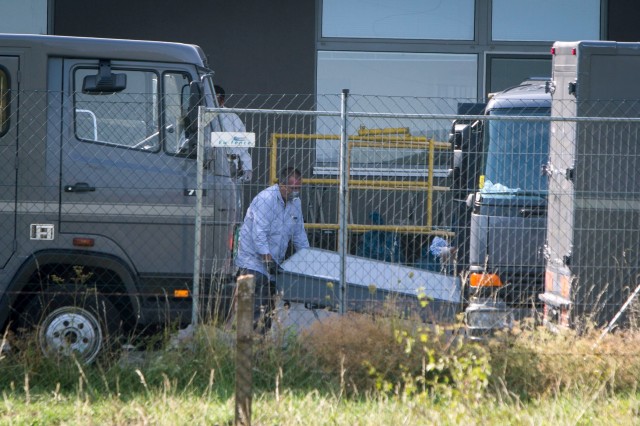
A worker handles a coffin containing the body of a migrant who died in an abandoned truck in Austria. AFP/Getty Images
Razor wire in Hungary, billy clubs on a Greek isle, riot police in France — the official response awaiting refugees as they pour into Europe from their war-torn, economically ravaged homelands to the south has gradually shifted from wary humanitarianism to calculated resistance.
Migrants have been herded off to barely habitable camps or, on Greek-owned Kos, locked overnight in a soccer stadium lacking basic sanitation and access to food or medicine. French soldiers stand guard at the mouth of the tunnel linking their country with Britain to prevent mad dashes for the U.K. Some who dared chance it have lost limbs. Others, their lives.
And still they come. Al Jazeera estimates that “340,000 have crossed European borders so far this year, representing a 175 percent increase over the number of asylum seekers who entered Europe over the same period last year.”
Yet, even as the camps swell and scores more wait at the edge of Calais, France, for the right moment to risk their lives anew, even as new boats are launched and new barriers scaled or otherwise breached, European Union leaders cannot agree on how best to handle a crisis that many fear may come to define their time in power.
The European Commission has proposed that the E.U.’s 28 member states each accept a quota, and many an observer has seconded that as perhaps the most equitable option. The very idea, however, has met with scorn in several countries, including Britain, France and Spain, three historical gateways to other nations, if not destinations in and of themselves, for the refugees, the majority of them Middle Eastern or African.
François Crépeau, the United Nations’ special rapporteur on the human rights of migrants, told Al Jazeera that there could be no “military solution” to stem the tide. Short of that, some countries have erected flesh-ripping fences, deployed tear gas, cracked heads and, in the case of Slovakia, publicly expressed a willingness to accept Christian refugees only, a policy echoed by Poland. All insist they have a right to handle the emergency their way.
But all this response has produced so far is overcrowded holding areas, overwhelmed public servants and misery all around, while the refugees, undaunted, keep streaming in on rickety boats or keep putting their trust in the mercenary hands of human traffickers. As Crépeau said:
Let’s not pretend that what the E.U. and its member states are doing is working. Migration is here to stay. Building fences, using tear gas and other forms of violence against migrants and asylum seekers, detention, withholding access to basics such as shelter, food or water and using threatening language or hateful speech will not stop migrants from coming or trying to come to Europe.
On Friday, the world learned of the latest related tragedies: More than 100 refugees died trapped in the hold of a boat that had capsized off the coast of Libya. And a baby girl and dozens of other Syrian migrants perished while locked inside a freezer truck abandoned in Austria. A day later, a minivan containing 26 migrants was discovered after the driver’s attempts to evade Austrian authorities spurred a police chase. Three children were found to be alive, but severely dehydrated.
As more countries go to extreme lengths to shutter their borders and treat asylum seekers as thoroughly unwelcome, business is thriving for those entrepreneurs looking to profit from their fellow man’s desperation. The Washington Post reports that so far this year at least 2,500 migrants have lost their lives attempting to enter Europe.
For the record, arrests have been made in the case of the freezer-truck deaths. Hungarian authorities say a network of human traffickers brought the victims in, then left them to die alongside a highway.
And, according to the BBC, E.U. leaders, responding to public outrage, have called an emergency meeting. Proclaiming the crisis one of “unprecedented proportions,” they plan to gather on Sept. 14 to discuss border controls, areas of safe passage, strategies to combat smuggling and an orderly process for determining which migrants are most deserving of assistance.
Such gatherings in the past have produced little but talk and half-hearted assurances. It is unlikely, however, that E.U. leaders will be able to endlessly pontificate without taking action. In the wake of the latest wave of migrant deaths, as leaders blamed each other, two world leaders have directly challenged Europe to quit bickering and do its part to put things to rights.
In his Sunday service in St. Peter’s Square, Pope Francis called on the international community to “do something to put an end to the violence and abuses” of the migrants. And U.N. Secretary-General Ban Ki-Moon issued a statement last week appealing to “all governments involved to provide comprehensive responses” and obey international law recognizing “the right of refugees to protection and asylum.”
Additionally, E.C. President Jean-Paul Juncker has exhorted leaders to show courage in the face of the worst refugee crisis since WWII, and follow through on the implicit commitments made to those seeking protection within Europe’s borders. German Chancellor Angela Merkel, too, has identified the migrant situation as one that has reached a boiling point, describing it as a bigger challenge than the recent financial meltdown in Greece.
But, although all concerned parties seem to agree that it is well past time for significant action, the question is, will these latest impassioned pleas prove any more effective than that of Maltese Prime Minister Joseph Moscat in April, when 900 migrants were feared lost in the waters off Libya? As Moscat warned then:
What happened . . . was a game changer. There is a new realization that if Europe doesn’t act as a team, history will judge it very harshly, as it did when [Europe] closed its eyes to stories of genocide — horrible stories — not long ago.


