


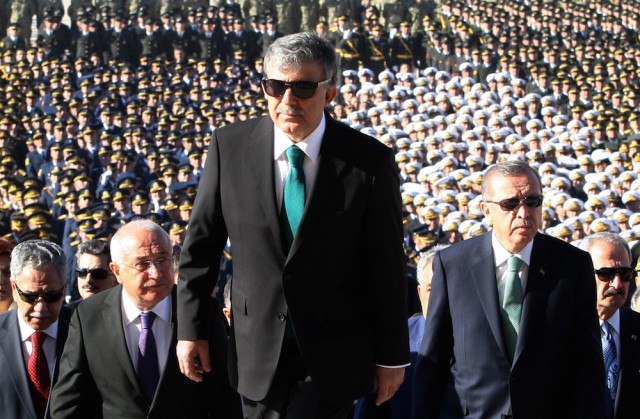
Turkey’s President Abdullah Gul and Prime Minister Recep Tayyip Erdogan in Ankara. AFP PHOTO/ADEM ALTAN
With only months to go before Turkey’s presidential elections, Prime Minister Recep Tayyip Erdogan is more visibly laying the groundwork for his widely-expected bid for the Turkish presidency. In a speech to parliament on Tuesday, the leader assured lawmakers that the elections would be held without sparking tensions that could threaten the economy. “We will complete this process without allowing the slightest risk to the economy and democracy, or uncertainty” said Erdogan, in thinly-veiled warning to his opponents.
Erdogan has not officially announced his candidacy though he has heavily hinted at his interest in the office, whose authority he has sought to expand with an eye towards his own political future — and at the expense of the country’s current parliamentary system. Last week, the leader remarked that Turkey was on its way to getting “a sweating, running president who gives orders, not a ceremonial president,” according to a report by the Sabah newspaper. (No word on how current president Abdullah Gul took the indirect denigration of his own current position).
Erdogan’s assurances around economic stability come as a significant annual meeting of Turkey’s central bank prepares to convene this Thursday. According to Reuters,
Economists say the normally innocuous general assembly, at which executives and technocrats are elected and reshuffled, has taken on greater significance this year after Erdogan called two weeks ago for an emergency interest rate cut to boost the economy.
Economic growth has long been a selling point for Erdogan and his Justice and Development Party (AKP). The central bank’s decision to buck his proscriptions and institute a massive rate hike back in January clearly disturbed the P.M. and it’s clear that he is eager to avoid a similar situation in the lead up to the August election.
via: country.eiu.com
The leader also appears to be making an effort to resolve another big question mark around the elections — namely, the position of his longtime comrade Gul, who has on recent occasions notably distanced himself from Erdogan, including during last month’s uproar over the government’s ban on Twitter. Months of speculation around the two leaders preparing for a Putin-Medvedev style switchover is unlikely to pan out, as Gul would need to be elected as a lawmaker first in order to become prime minister. Many have also suggested that Gul may contest the presidency himself in response to the appearance of a rivalry between the two following political divergences, as in the case of the Twitter disagreement. A report by the Radikal daily suggests that the two leaders have already decided on their path forward, with Gul running for chairman of the AKP and leaving the presidency open for Erdogan (and there is some precedence here: Gul relinquished the premiership back in 2002 for Erdogan).
The normally combative Erdogan will need to be on his best behavior to navigate these clear pitfalls ahead of the August election. After all, the already high-stakes contest is more loaded with political significance than ever as it would mark the first Turkish president elected by popular vote. There’s almost no doubt that Erdogan will enter the race — the question will be how little drama he can manage around his bid.


