


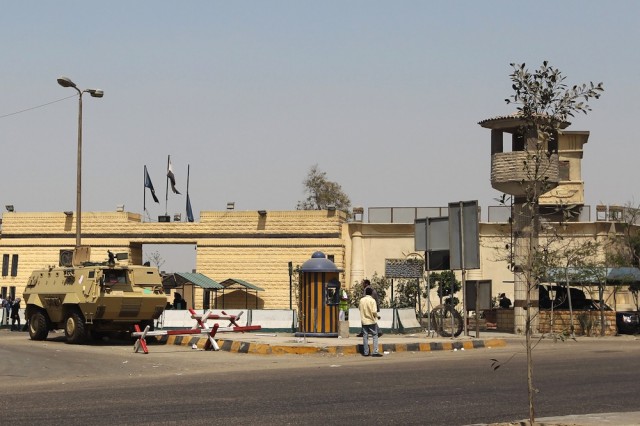
Egypt’s notorious Tora Prison. (AFP PHOTO / KHALED DESOUKI)
As the third anniversary of Egypt’s 2011 uprising approaches, there is a lot to lament about the realization of the revolution’s goals following three years of political tumult and the deposition of the country’s first democratically elected government in July. The sense of regression to the pre-revolutionary era is as pronounced as it ever has been since former strongman Hosni Mubarak was deposed- even if the country’s media, obsessed as it is with the interim government’s “war on terror,” is loath to admit it.
The reminders of the abject state of Egyptian democracy in the wake of the coup are everywhere (a report from Amnesty International released on Thursday gives a comprehensive overview). But perhaps one of the most devastatingly resonant is a recently released letter from within Egypt’s notorious Tora Prison, written by Alaa Abdel Fattah, among the most prominent of Egypt’s 2011 revolutionary leaders.
Abdel Fattah’s dispatch (translated into English here) is remarkable in that it is not a political screed; the letter, addressed to the activist’s sisters, is a deeply personal meditation on imprisonment and love of family:
But all of these are little things that confirm the reality of imprisonment, that your willpower is completely taken away from you and someone else is controlling your time and body. The problem is that someone else is controlling my soul and limiting when I can see Manal and Khaled and when and how much I can kiss and hug them.
Abdel Fattah, who is facing charges of organizing an illegal protest under provisions of a November law criminalizing unauthorized demonstrations, is not unfamiliar with politically-motivated detentions. As a member of a well-known activist family, the revolutionary leader had run ins with both the Mubarak regime and the Muslim Brotherhood government of Mohammed Morsi. The experiences, according to him, have not made his current ordeal any less tolerable:
You know that I hate the whole “You are free and imprisonment will not be able to break you” tone. Every time I am jailed, a piece of me breaks, just like every time someone else is imprisoned, a piece of us breaks.
The letter is an unusual entry into Egypt’s polarized political discourse because of its ostensibly apolitical, personal tone. It is also a stark representation of the turn the country has taken since the immediate aftermath of the uprising, where the activists who once triumphed over dictatorship now sit in the very same jail from which the deposed dictator was released only months ago. Abdel Fattah’s imprisonment on charges which criminalize the means through which the January 25 revolution took place should again serve to illustrate that the state security apparatus’s Mubarak-era tactics are back and in better shape than ever — after all, this time the military regime enjoys widespread support among the Egyptian public.
As resonant as Abdel Fattah’s dispatch may be, a new “Letter from a Birmingham Jail” this is not. Any sympathy elicited at the activist’s plight will be divorced in the public’s mind from any real support for his cause — the condemnation of the military government’s powers.


Pingback: Ansar Beit al-Maqdes strikes Cairo | BLOUIN BEAT: World