


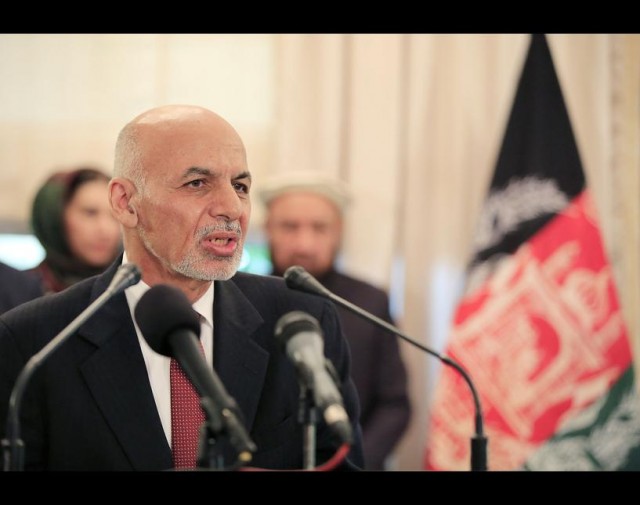
Afghan President Ashraf Ghani Ahmadzai on November 15, 2024 in Islamabad, Pakistan. Anadolu Agency/Getty Images
A suicide bombing in Afghanistan killed nine people on Monday, in an attack that targeted police and government officials in Baghlan province, north of Kabul. The deadly bombing came one day after a government reshuffle in which newly elected President Ashraf Ghani dismissed most of his cabinet.
Both events illustrate the steep challenges facing the new president: security concerns in the lead up to the withdrawal of foreign troops at the end of the year, and the difficulties of asserting influence after nabbing a narrow lead in Afghanistan’s heavily contested presidential election. (The messy race saw both candidates assert election fraud; a narrow run-off gave Ghani the victory, but only after a prolonged contestation and mediation by U.S. Secretary of State John Kerry). The resulting power-sharing deal means Ghani must rule alongside a chief executive – his opponent in the presidential race, Abdullah Abdullah — and two vice presidents, which has complicated the president’s job from the start, notably his promise to form a new cabinet within 45 days of taking office. Not to mention the specter of former president Hamid Karzai, reportedly keen to maintain his influence in Kabul.
The uneasy unity government now in place has done little to alleviate Afghanistan’s security situation, which is worsening as the prospect of a security vacuum grows more tangible. Indeed, Ghani and company have been unable even to agree on the shape of a new cabinet, i..e, how to split a slate of plum jobs. Little wonder then that the president is cleaning house. On Sunday he announced that most of the current ministers would be dismissed, and replaced by their deputy ministers until new appointments could be made. The same day, Kabul police chief, General Zahir Zahir submitted his resignation in relation to a series of intensifying suicide bombings in the Afghan capital, including an attempted attack on the local police station. (On Monday, however, Zahir’s resignation was rejected by his superiors.)
Amid the government reshuffle promised by Ghani, look for Western-friendly appointees (unlike his predecessor, Ghani has taken a more conciliatory approach with Afghanistan’s Western allies) as well as several technocrats à la the U.N. official, and humanitarian activist he has already tagged for his administration. Insiders predict that the entire cabinet will be replaced. And Ghani’s sweep doesn’t look to end there. The president plans to dismiss senior military and civilian figures in several provinces heavily affected by Taliban violence in the hopes that such an overhaul will provoke new momentum in the campaign against terrorism. The move coincides with a comprehensive review of the country’s military strategy and the extension of a bilateral security agreement with the United States to prolong that country’s military presence in Afghanistan.
So the president is busy. Capping off his domestic activity, Ghani embarked on a trip to Europe this week alongside Abdullah in what is meant to be a public show of unity. But without a government in place at home, it remains to be seen if all the hustle and bustle will pay off.


