


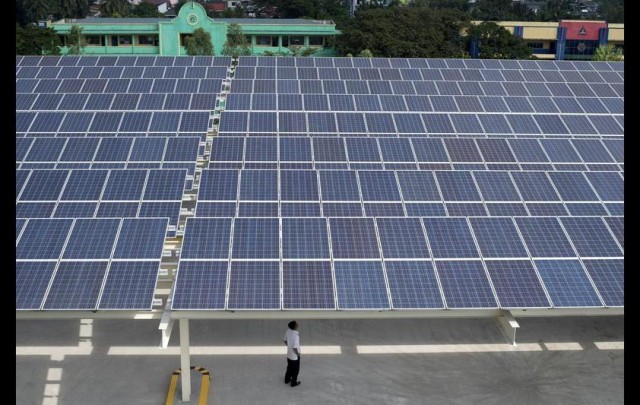
Solar panels at the roof deck of a mall in Manila on November 24, 2014. NOEL CELIS/AFP/Getty Images
On Tuesday, Solar Philippines launched the construction of a 50MW solar park, the biggest yet on the island of Luzon. Electricity consumption in the Philippines, which is expected to be the world’s second fastest-growing economy this year, jumped 50% in the decade preceding 2012, far outpacing a 16% increase in generating capacity. Yet solar energy accounts for less than 0.01% of the country’s energy supply, which is overwhelmingly reliant on imported fossil fuels. But in 2014, the government began forecasting a looming power crisis for this year, spurring the Department of Energy (DOE) to significantly expand its solar power targets and approve more projects.
In November, President Benigno Aquino III inaugurated what was then the country’s largest solar project, rooftop panels for a shopping mall that generate 1.5MW. But as of the end of January, the DOE had awarded 69 solar projects under the Renewable Energy Act, with an additional 34 pending. The government’s current solar target, 500 MW by 2016, is a ten-fold increase from its initial target.
The government has promised that consumers’ electricity prices would only see a minuscule rise due to the increased solar target. The key to this is adroitly managing the feed-in-tariff (FIT), which pays a fixed price per kwh to renewable energy producers who sell to the national grid. Producers favor a higher price while consumers favor a lower one, clearly; thus far, the government has been leaning towards the consumers and potential voters. The FIT rate for renewables, approximately $0.21/kwh, is one of the lowest in the world. However, electricity in the Philippines is still among the most expensive in Asia, and the price of solar panels keeps dropping, so the government is considering decreasing the FIT slightly.
Developers will likely still be profitable, especially when other generous government incentives are factored in. These include an income tax holiday for the first 7 years of commercial operations, additional income tax exemption on income derived from subsequent investments in the projects, and duty-free importation of renewable-energy machinery, equipment, and materials in the first 10 years, according to Rappler. They are also exempt from value-added tax on purchases of local goods, properties, and services needed to build the facilities.
Solar Philippines President Leandro Leviste said that there’s a lot of competition to get it on the FIT allocation. With over a dozen contracts to develop solar projects near major cities across the country, his company plans to complete at least 200 MW in 2015. Likewise, in the past several months, a fair amount of other solar projects in the 20-100MW range have been planned or started. These are usually joint ventures between a foreign solar company and a local one. 100MW of solar plants will be built this year by each of the following pairs: SunEdison and Aboitiz Power Corp.; Urbasolar and SunAsia Energy; and Bronzeoak Philippines Inc. with Thomas Lloyd Group.
Some Filipinos are not entirely sold on the solar surge. Congressman Agapito Guanlao said on March 6 that studies and impact assessments must first be conducted to ensure that any such push does not imperil food security by taking up too much arable land. However, Leviste may have just the answer to that, noting “This is the year to convert unproductive lands into solar farms.”


