


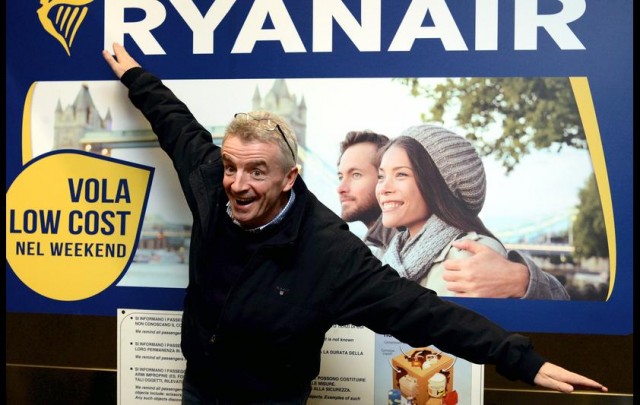
Michael O’ Leary, CEO of Ryanair at a press conference in Bergamo, Italy, January 27, 2015. Pier Marco Tacca/Getty Images
Irish low-cost airline Ryanair announced on Monday that its board had approved transatlantic flights, a new growth direction for the company. The company estimates that its routes between 12-14 different European cities and the same number of American cities would be operational in 4-5 years.
These plans depend on Ryanair’s ability to secure a fleet of long-haul jets, and the company said discussions were already underway with manufacturers. The difficulty of acquiring these aircraft is the main limiting factor. Speculating on a possible long-haul strategy, Ryanair’s CEO Michael O’Leary said in November “There is a historical shortage. We can’t get the aircraft we need for three or four years.” Boeing and Airbus are the main contenders for a potential deal, and competition will be fierce. Boeing is Ryanair’s current supplier, and its most recent contract to provide 200 jets to the airline went for a mouthwatering $22 billion.
Ryanair’s foray into the lucrative transatlantic game follows that of two other low-cost European airlines: Norwegian Air Shuttle and Iceland-based WOW Air. Ryanair has become extremely popular and successful by focusing on the European market, for which it said transatlantic flights are a “logical development.” The airline carried 90 million passengers in 2014, an increase of 9 million from 2013, and it has been taking market share from all of its competitors, including EasyJet and British Airways. Ryanair predicts it will have 100 million passengers this year, as it strives to become the world’s biggest carrier and “the Amazon of travel.” It recently made a $280 million purchase of three Boeing aircraft for delivery in early 2016, and O’Leary said the airline aims to expand its traffic to 160 million customers a year by 2024.
Ryanair’s rising fortune is good for others as well. In early March, the airline announced it would begin service from London and Bristol in the U.K. to Castellón-Costa Azahar Airport in Valencia, Spain — a “ghost airport” that has not been used by any airline since it opened in 2011. Costing over $150 million with no demand foreseen, the Castellón airport has been an embarrassing symbol of Spain’s reckless spending and the sudden bust of its construction boom in 2008. This year, however, Ryanair said it expected around 18,000 passengers to fly the new routes, eventually rising to around 60,000 passengers a year. This would bring a welcome influx of tourist revenue to the local economy, which, like the rest of Spain, is still struggling with stagnant economic growth, high debt, and high unemployment.
The flights to Valencia will follow Ryanair’s successful budget-traveler model, and they are bound to be profitable. However, to make transatlantic flights viable, low-cost seats for thrifty tourists will have to be balanced by higher-priced seats for business travelers. The big question is: can Ryanair expand its appeal beyond its traditional core?


