


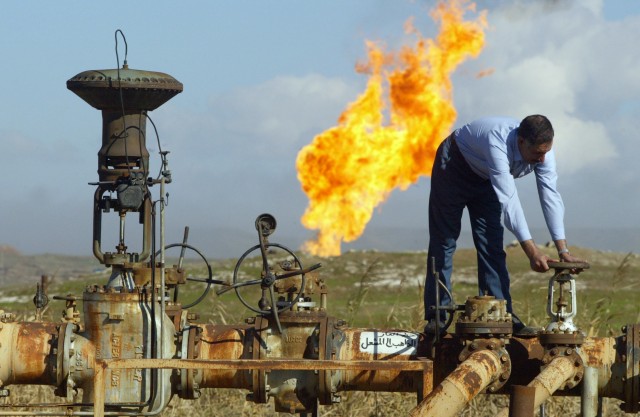
A worker turns a valve at the Shirawa oilfield outside the northern city of Kirkuk, in a file image. AFP
Sparring between the semi-autonomous Kurdistan Regional Government (KRG) and Iraq’s central government over the resource that holds the key to the country’s future prosperity, oil, has no end in sight. The dispute risks destabilizing the country, the region and world oil markets as Kurdistan strives for independence and positions itself as an attractive, and still underexploited, opportunity for foreign oil companies.
On Thursday, Baghdad said that it was considering a proposal from British oil giant BP to begin work in the Kirkuk oil field, located along the border between Iraqi Kurdistan and the rest of Iraq, to reinforce its authority over the region –the KRG rejected the deal. These words were only the latest in a series of threats by the central government that range from cutting the semi-autonomous region’s budget to the deployment of Iraqi soldiers along the fault-line that divides the Kurdish region from the rest of the country.
Meanwhile, Kurdistan has been ignoring an agreement to have the central government act as export agent for its oil. It has begun exporting its own crude, delivered by truck to Turkey, rather than through the Baghdad-controlled Iraq-Turkey pipeline. Independent oil producer Genel Energy is behind direct exports from the Taq Taq oil field, saying that is a cheaper way to deliver the supply. Trafigura and Vitol, two of the world’s largest energy trading houses, are also exporting Kurdish light oil by truck to a Turkish port, whither it is sold into world markets via an intermediary.
The moves are a clear step forward from the KRG towards their desire to gain financial and, subsequent political, independence from Baghdad. The federal Iraq created after U.S. troops left is fragile. The possibility that Iraqi Kurdistan, which has run its own regional administration and armed forces since 1991, could break away could encourage other regions and even religious factions to claim autonomy as well.
The KRG also believes it is free to deal with foreign oil companies while Baghdad insists that it has the sole right to award exploration and production contracts. The former wants to become a leading energy player in its own right while the latter seeks to tap the potential of the country’s vast, but still war-wracked, oil reserves. They are thought to total 350 billion barrels with which Iraq intends to fortify its status as the world’s third largest oil exporter.
Some 45 billion barrels of those reserves are believed to lie below Iraqi Kurdistan. In December 2011, Exxon Mobil, the world’s largest non-state-owned oil company, signed a deal with Iraqi Kurdistan to search for some of them. Even though that soured relations between Baghdad and the company, putting existing contracts in the south at risk, other energy groups have followed suit. Total, Chevron and Gazprom are among those that have closed deals. In all, the KRG has concluded some 50 production-sharing contracts, the International Energy Agency says. Iraq threatens to sue companies exporting crude from Kurdistan.
Iraq, which has seen its oil exports rise in part because of the international sanctions against Iran, can see the risks to its energy ambitions if oil companies continue to close deals with the KRG. It may have to ease the exacting conditions on foreign companies it has imposed on the oil contracts it has awarded in the south, or, politically more challenging, find a way to work with the KRG to share revenues from the oil fields in both the north and south of the country.
For now, Turkey is the largest benefactor from this conflict. Last year, trade between Turkey and Iraqi Kurdistan amounted to $8 billion, according to The Economist. The trade is likely to grow this year. Relations between Iraq and Turkey are at a low point after Baghdad’s decision to expel Turkey’s state oil company from an exploration consortium.


Pingback: Ex-BP’s Hayward: from the Gulf of Mexico to Kurdistan | BLOUIN BEAT: Business