It was an autumn auction season dominated by sales of extraordinary single diamonds: the flawless 118.28-carat white that sold for $30.6 million at Sotheby’s Hong Kong in October, becoming the largest colorless example ever sold at auction; the 14.82-carat fancy vivid orange that achieved $36 million at Christie’s Geneva in November; and the 59.6-carat Pink Star, renamed the Pink Dream upon achieving $83 million at Sotheby’s Geneva the following evening. Cartier, one of the salesroom’s stalwart luminaries, could hardly be content to stand idle in the face of the gem world’s rapt attention to the rainbow coalition of heavyweight stones. Indeed, while those gems were in the spotlight, the iconic French jeweler was putting the finishing touches on its monumental “Cartier: Style and History,” currently on view through February 16 at La Réunion des Musées Nationaux–Grand Palais in Paris. Flaunting some 600 pieces, the behemoth exhibition turns attention from the category’s unparalleled dominion over the concept of portable wealth back to its singular capacity to forge technical virtuosity and artful expression into objects that manifest the devoutly personal and ephemeral notions of nostalgia, sentiment, dream, and desire.
Such a plethora of examples could hardly all come from the company vault. Several of the most important jewels were lent by private owners, one of the most exceptional being Elizabeth II, the reigning English monarch, who gave up a regularly worn piece, the Edelweiss brooch, as well as the tiara worn by the Duchess of Cambridge during her 2011 wedding, for the duration of the show.
Cartier is now becoming yet another collector of its own great pieces, realizing there is likely none better to showcase its creations as cultural icons. “Museum professionals visit our archives to see how we care for our collection,” says Pascale Lepeu, curator of the Cartier trove. “It’s not only a preservation of jewelry history, but of French history.”
The show’s organizer, Laurent Salomé, chief heritage curator and head of exhibitions at the Grand Palais, has achieved his goal of examining Cartier’s oeuvre through the lens of art history. “We knew it would be an interesting subject,” he says, referring to himself and his assistant Laure Dalon, a heritage curator at the museum. “But we were amazed by how well it addresses the entire history of style.”
Although the show covers all of Cartier’s 166 years, with not only jewels and jeweled objects but also clothing, furniture, paintings, photographs, and archival documents, special attention must be paid to the Art Deco era, roughly 1905 to 1938, when the maker sought to distinguish itself—as did Carl Fabergé, René Lalique, Louis Comfort Tiffany, and other important jewelers of the day—by creating a unique style and identity. “When I talk to collectors or clients,” says Carol Elkins, a senior specialist at Sotheby’s, “at the apex of the pyramid is Cartier Art Deco made in the 1920s. I started at Sotheby’s in 1986, and that really hasn’t changed.”
Founder Louis-François Cartier’s grandson Louis took control of the company’s artistic direction at the dawn of the 20th century, along with his designer Charles Jacqueau and director of accessories Jeanne Toussaint. Their aim, says Salomé, was to marry classical French garland forms with the modern influences found throughout the high culture of the day to create “objects for independent, modern, and provocative people.” Even before World War I, Cartier designs moved into abstraction, using geometric forms to reflect changing social ideologies. “It’s an interesting mix of symbols,” says the curator of these compositions.
“Initially the company wanted to appeal to the ancien régime, but it realized aristocrats were not its only clients,” Salomé continues. “The rise of Art Deco reflects the rise of a new elite.” Nonroyal patrons credited with bringing the house celebrity cachet included Singer sewing machine heiress and Harper’s Bazaar Paris fashion editor Daisy Fellowes, General Foods founder Marjorie Merriweather Post, tobacco heiress Doris Duke, and film star Gloria Swanson. Today, of course, the commissions of these clients cause buzz on the auction block. “There’s always excitement when you have a lot with provenance,” says Elkins. “Learning about a piece’s history is like peeling back an onion.”
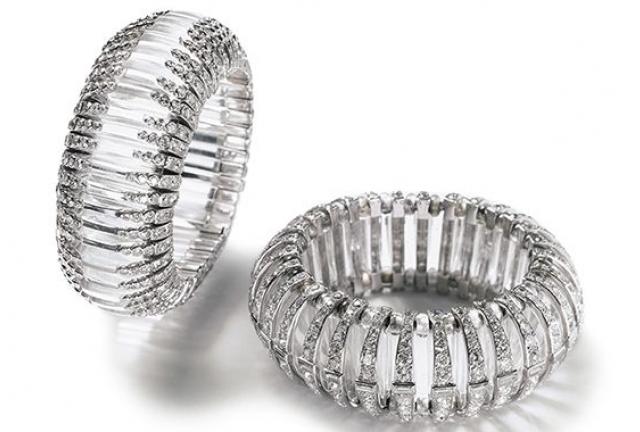
In addition to democracy, forward thinking included the embrace of technological advances that allowed the use of new materials. Specifically, Art Deco designs incorporate platinum, an extraordinarily hard white metal that does not tarnish—an advantage when fumes from gas lighting could blacken silver jewelry settings by the end of a single evening. The strength and ductility of the material also allows it to be fashioned at extremely thin gauge, endowing Art Deco designs with settings that Cartier himself likened to embroidery. Additional material innovations included the use of black onyx and a variety of previously unused diamond cuts such as baguettes, hexagons, and half-moons. These, together with the house’s expanding use of platinum, yielded an abundance of black-and-white designs that emphasized form in the absence of color. “Cartier was among the first houses to experiment with the new rectilinear cuts,” says Elkins.
Matte, glossy, and transparent semiprecious gems, such as rock crystal and moonstone, were used by Cartier’s designers for the subtle ways they caught light, and patrons became aware of how they added sparkle to photographic portraiture as captured by Studio Harcourt and Sir Cecil Beaton. Pearls—which at the time were more valuable than diamonds, as their farming had yet to be developed—remained extremely important to Art Deco designs, not only for the black-and-white examples but also for the house’s stylized floral and antique motifs that riffed on its Belle Epoque compositions. “Cartier always refers back to its classical roots,” says Salomé.
Although black-and-white geometry might be the best-known of the period’s designs, Art Deco is also marked by an exotic use of bold color, combining red, blue, and green stones and giving rise to the use of turquoise, coral, and aquamarine. On the European front, this innovation was inspired by the fine-art movements, such as Fauvism and German Expressionism, that were generating excitement at the time, as were productions mounted by Sergei Diaghilev’s Ballets Russes. But the use of color was also catalyzed by the global travels of both Cartier brothers, Louis and Jacques. “Cartier was remarkably open to exotic influences,” says Amin Jaffer, international director of Asian art at Christie’s and author of a recently completed compendium of Indian jeweled objects, Beyond Extravagance: A Royal Collection of Gems and Jewels. A 1903 Museé du Louvre exhibition of Islamic art compelled Louis to combine blue and green stones. The following year, what would now be called a pop-up boutique was mounted for the extent of the St. Petersburg social season, giving Louis greater exposure to the Fabergé works he had admired during the 1900 Exposition Universelle in Paris, and leading him to hire Russian enamel artisans.
“Jacques went to India in 1911 to look for clients as well as stones,” says Jaffer. The excursion was bountiful, resulting in relationships with maharajas who not only commissioned the house to remake ancient jewels—thus giving its artisans invaluable lessons in traditional techniques— but also purchased the new designs. For Western clients, Cartier began to produce “pieces that were Indian in scale and also in function,” says Jaffer, referring to creations fashioned to be worn on the forehead or as armbands. A style using multiple colored gems and incorporating both carved and antique stones found in the region became known as tutti-frutti.
The 1922 discovery of the tomb of Egyptian pharaoh Tutankhamen furthered the use of antique stones and even found objects. A trio of pieces from this period—a 1923 faience, diamond, and colored-stone pylon brooch; a faience and jeweled brooch from the same year; and a platinum, faience, coral, diamond, and pearl Isis stickpin—are thought to have appeared in an advertisement in the January 26, 1924, edition of the Illustrated London News. They were reunited for this past December’s Magnificent Jewels sale at Sotheby’s New York. Two of the pieces once belonged to the estate of Iya, Lady Abdy, a Russian émigré to Paris who lived on the Place Vendôme, which endows them with special resonance. That history and a client’s desire to reach back to the past is what “transforms a jewel from an accessory to a precious object,” says Salomé.
A collector of 18th-century furniture and an admirer of interior and fashion design, Louis Cartier sought to raise the level at which his wares were regarded by insisting that his booth for the 1925 International Exhibition of Modern Industrial and Decorative Arts in Paris appear alongside those of couturiers Worth, Jenny, and Lanvin in the Pavilion of Elegance, and not at the Grand Palais with the other jewelers. “It’s always been one of their strategies to differentiate themselves from other makers, to give a different status to jewels,” says Salomé.
One can “really write the history of the 20th century as expressed by jewelry design,” declares Elkins. As Salomé puts it, “ ‘Jeweler’ is not the perfect definition for what Cartier is.”
-- Deborah Wilk